Plugged In and Hired: The Electric Vehicle Shift Is Creating Automotive Jobs You Have Not Heard Of Yet
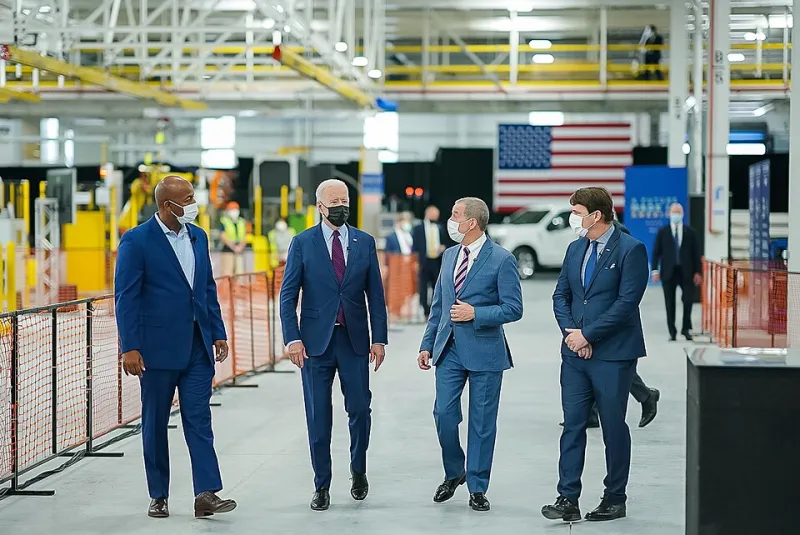
Photo: The White House, Public domain, via Wikimedia Commons
The US automotive industry is in the midst of a structural transformation that arrives once in a generation. Electric vehicles, once a niche category dominated by a single manufacturer, now represent a meaningful and growing share of new vehicle sales across virtually every major brand. Ford, General Motors, Stellantis, Hyundai, Toyota, and BMW all have expanding EV lineups competing for American consumers. Behind each of those vehicles sits a growing demand for workers who understand how to sell, service, diagnose, and support them.
For job seekers and career changers monitoring the market through resources like CarLife Staff, the timing is significant. The window to position yourself as an EV-qualified professional — before the broader workforce catches up — remains open, but it is narrowing.
The Technician Gap Is Real, and It Is Paying Well
Traditional internal combustion engine technicians are skilled professionals, but the diagnostic and repair requirements of electric vehicles differ substantially from what most of them encounter daily. High-voltage systems, battery management architecture, regenerative braking, and over-the-air software updates introduce an entirely new set of competencies.
Dealerships that have invested in EV inventory are actively struggling to find technicians qualified to work on these vehicles. According to industry workforce analyses, the shortage of EV-certified technicians is expected to intensify through the remainder of this decade as adoption accelerates. That supply-demand imbalance is already reflected in compensation.
EV-certified technicians at franchised dealerships in major US markets — California, Texas, Florida, New York, and the Pacific Northwest — are commanding hourly flat rates and salaries that run measurably above their non-certified counterparts. Some technicians with specialized battery diagnostic training report earnings that rival or exceed those of Service Advisors, a notable shift in the traditional dealership pay hierarchy.
Certifications That Are Actually Worth Pursuing
Not all credentials carry equal weight in the hiring market. For technicians seeking to enter or advance within EV service, several certifications have emerged as meaningful differentiators.
The ASE Electrical/Electronic Systems (A6) certification, while not EV-specific, provides essential foundational knowledge. The ASE Electric/Hybrid Vehicle Specialist (L3) certification is increasingly requested by dealerships with significant EV inventory and carries demonstrable market value.
Manufacturer-specific training programs represent another significant avenue. Tesla, General Motors (through its EV Live curriculum), Ford (via its Pro Power and F-150 Lightning training), and Rivian all offer technical training that, in many cases, is available to dealership technicians at no cost. Completing these programs not only builds competency but signals to hiring managers that a candidate is proactive about staying current with the industry's direction.
For those interested in battery systems specifically, community colleges and technical institutes in states with strong EV adoption — particularly California, Michigan, and Colorado — have begun offering battery technology and high-voltage systems coursework. These programs are producing graduates who are attractive to both dealerships and independent service operations.
New Roles That Did Not Exist Five Years Ago
Beyond the technician role, the EV transition is generating entirely new positions within dealerships and adjacent businesses. Understanding these emerging titles is valuable for anyone mapping their career options.
EV Product Specialist / EV Concierge: Several dealership groups have created dedicated roles for sales professionals who specialize exclusively in electric vehicle education. These individuals guide customers through range considerations, charging infrastructure, tax incentive eligibility under the Inflation Reduction Act, and home charging installation logistics. The role blends product knowledge with consultative selling and is increasingly well-compensated.
Charging Infrastructure Coordinator: As dealerships build out their own DC fast-charging networks and partner with charging providers, someone must manage vendor relationships, maintenance scheduling, and customer communication. This operational role is appearing at larger dealer groups and regional automotive retailers.
Remote Vehicle Diagnostics Technician: Some manufacturers and third-party service providers are developing remote diagnostic capabilities that allow technicians to assess vehicle software issues without the customer bringing the car in. This role exists at the intersection of automotive knowledge and technology, and it is attracting candidates from both the service bay and the IT sector.
Battery Health Analyst: At the intersection of data analysis and automotive service, this role involves evaluating battery state-of-health reports, advising on warranty claims, and helping dealerships manage pre-owned EV inventory with accurate battery assessments. It is particularly relevant as the used EV market expands.
Traditional Roles Being Reimagined
The EV transition is not eliminating traditional automotive roles so much as it is redefining what competency within those roles requires. Service Advisors, for instance, now need to be fluent in explaining software update schedules, charging behavior, and battery warranty terms to customers who are often unfamiliar with these concepts. Advisors who invest in EV literacy — even without being technicians — become considerably more valuable to their employers.
Parts professionals are navigating a shift in inventory composition. EVs have dramatically fewer moving components than combustion vehicles, which changes parts department volume and mix over time. However, high-voltage battery packs, charging components, and thermal management parts introduce new procurement relationships and inventory management challenges. Parts specialists who understand these categories are ahead of those who do not.
Finance and Insurance Managers are also encountering new complexity. Federal EV tax credits, manufacturer financing incentives specific to electric models, and the growing availability of home charging equipment financing all require F&I professionals to expand their knowledge base.
Where the Hiring Is Concentrated
Geographically, EV-related automotive hiring is most concentrated in states with strong EV adoption mandates and infrastructure investment. California remains the largest market by volume. However, Texas, Georgia, Michigan, and the broader Southeast corridor — buoyed by significant EV manufacturing investment from companies such as Rivian, Hyundai, and Mercedes-Benz — are emerging as meaningful hiring centers.
Urban dealership clusters in metro areas including Los Angeles, Dallas, Atlanta, Nashville, and Seattle are reporting the most acute demand for EV-qualified personnel. Candidates willing to relocate or commute to these markets may find accelerated hiring timelines and stronger compensation packages.
The Strategic Case for Acting Now
The EV hiring market rewards early movers. Technicians who obtain EV certifications today are entering a labor pool that remains relatively small relative to demand. Sales professionals who develop genuine EV expertise are distinguishing themselves in a sales environment where customer education is often as important as the close itself.
CarLife Staff connects automotive professionals with dealerships, service operations, and automotive employers that are actively building their EV-capable teams. The industry is changing, the jobs are real, and the professionals who recognize this moment for what it is — a generational career opportunity — are the ones most likely to benefit from it.